Last updated November 17, 2026
Free written scope consultation - allowances, timeline, and change-order rules on paper before a single trade is scheduled
The Complete Fence Installation Guide for Torrance Homeowners
Here’s a fact that surprises most Torrance homeowners: the salt-laden marine air that rolls in off the Santa Monica Bay corrodes untreated steel hardware – hinges, post bases, screws, gate latches – faster than it degrades the fence boards themselves. A pressure-treated pine fence with standard galvanized fasteners in coastal Torrance will often outlive its own hardware, which means a gate that sags and swings crooked after four or five years while the boards still look fine. That gap between board life and hardware life is where most fence budgets quietly leak.
This guide sequences the decisions that actually determine whether a Torrance fence project finishes on budget: property-line law first, permit thresholds second, coastal material science third, and foundation engineering last. Get those four in the right order and the materials are the easy part.
Quick Answer
Fence installation in Torrance typically runs $4,200 to $9,800 for a standard 150-linear-foot residential yard, with coastal-rated materials and stainless or hot-dip galvanized hardware adding $600 to $1,400 to the inland equivalent. A City of Torrance fence permit is required for anything over 6 feet in a rear or side yard, and for any fence at all in a front yard adjacent to the street; permits run roughly $150 to $400 depending on linear footage. The order that matters: confirm the legal property line, confirm the permit threshold, then spec materials for salt air and expansive clay soil.
Styles & brands we work with
- Kitchen remodeling
- Bathroom remodeling
- Home additions & ADU
- Roofing
- Windows & doors
- Driveway & pavers
- Fence
Table of Contents
- Where Does Your Property Line Actually Run?
- Do You Need a City of Torrance Fence Permit?
- Coastal Material Durability: Wood, Vinyl, Aluminum, Steel
- Post Depth and Concrete in Torrance’s Clay Soils
- What a Written Fence Scope Must Contain
- Neighbor Law and Shared Fences in Torrance
- What Fence Installation Costs in Torrance
- Common Mistakes to Avoid
Where Does Your Property Line Actually Run?
The single most common reason a Torrance fence project stalls mid-construction is a property line that turns out to be 18 inches from where the homeowner assumed. Setting a post on the wrong side of that line creates a legal problem no amount of good carpentry fixes, and in a dense city like Torrance where lots in Old Torrance and the neighborhoods near Wilson Park were platted decades ago, the gap between assumption and reality is common.
A plot map from the Los Angeles County Assessor is not a survey. The assessor’s map is a tax document – it shows approximate parcel boundaries for assessment purposes and carries no surveyor’s certification. It is useful for understanding the general shape of your lot. It is not evidence of where your fence legally belongs.
What you actually need, in order:
- A recorded deed and plat description from the county recorder, which gives you the legal description of your parcel as written.
- A boundary survey by a licensed land surveyor, who will set or locate monument markers and stake the true line. In Torrance, expect $600 to $1,500 for a residential boundary survey, more if the lot is irregular or corners are missing.
- A written acknowledgment from the adjacent neighbor before posts go in, especially if your fence will sit on or near the shared line.
If a survey monument is already visible at a corner – a brass cap or a rebar with a plastic cap – a surveyor may be able to locate the line more cheaply than a full boundary survey. Ask about that specifically. It’s the difference between a $600 and a $1,400 line item, and it happens before you buy a single board.
Do You Need a City of Torrance Fence Permit?
Yes, in two specific situations. The City of Torrance requires a fence permit when a fence exceeds 6 feet in height in a rear or side yard, and requires a permit for any fence in a front yard adjacent to the public street, regardless of height. A 5-foot side-yard fence between you and your neighbor generally does not require a permit. A 7-foot privacy fence along your back property line does.
Height is measured from the finished grade on the higher side of the fence, which matters on sloped lots in the Hillside and Crest neighborhoods, where a fence that looks 6 feet tall from your patio may read 7 feet from the neighbor’s yard below.
The permit application typically requires:
- A site plan drawn to scale showing the fence line, dimensions, and distance from property lines and structures
- Fence height, material, and post spacing details
- The property owner’s information and, where applicable, the contractor’s license number
- Signed acknowledgment from the adjacent property owner if the fence sits on a shared line
Permit fees in Torrance run approximately $150 to $400 depending on linear footage and whether an inspection is required. In our experience, the inspection is where the details matter: post depth, concrete, and footing size are the three things a city inspector checks, and a crew that set posts before pulling the permit has no recourse if the depth doesn’t pass. Under Clause 1 of the Haven Standard, permits are pulled before work starts, not after – that’s a written price and a documented scope, not a promise made after the fact.
If you’re coordinating a fence with a larger exterior project, our guide to Driveway & Pavers in Torrance covers how hardscape and fence lines should be sequenced so neither crew tears up the other’s finished work.
Coastal Material Durability: Wood, Vinyl, Aluminum, Steel
Material choice in Torrance is a salt-air question first and a budget question second. The marine layer that keeps the South Bay cool also deposits chloride on metal surfaces, and chloride accelerates corrosion on standard galvanized hardware dramatically compared to an inland installation ten miles east in Gardena or Compton. The right question is not “which material lasts longest” in the abstract – it’s “which material, with which coating grade, survives Torrance’s specific air.”
Pressure-treated wood
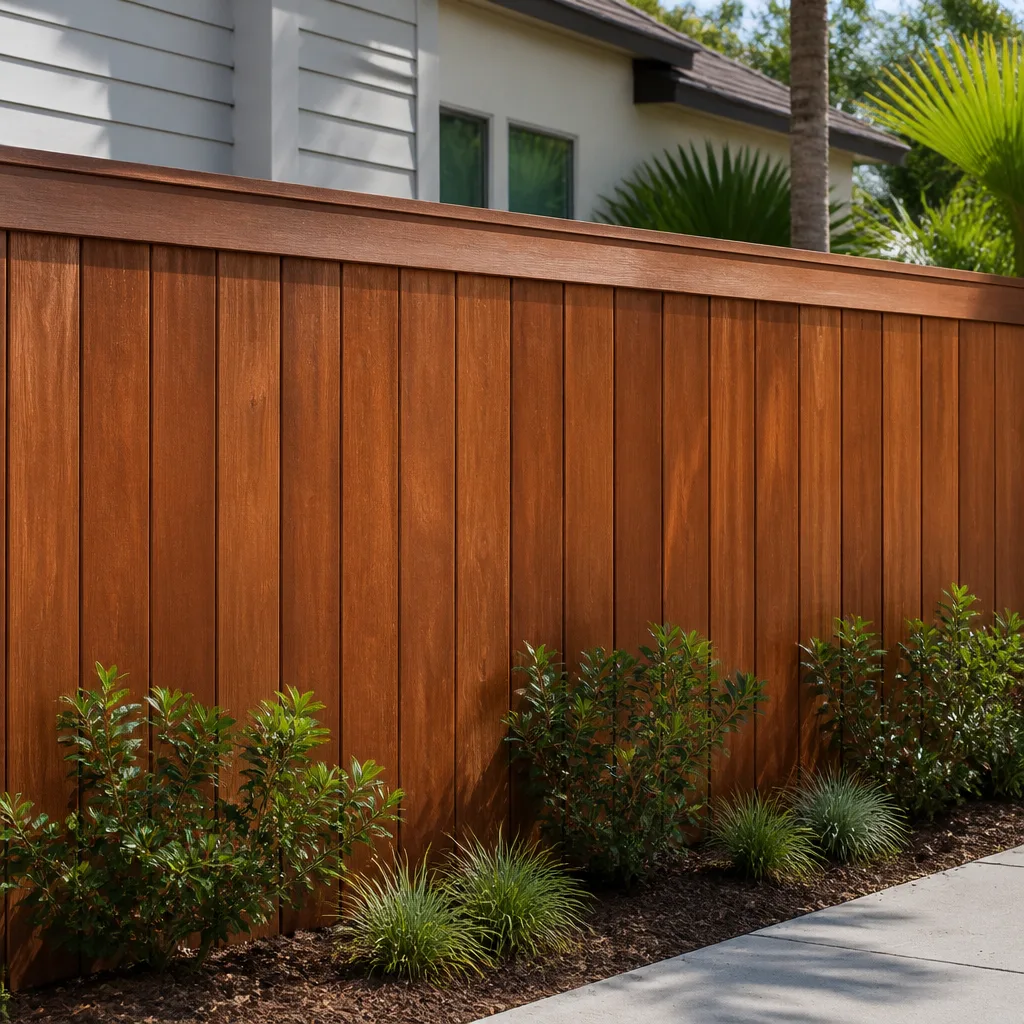
Ground-contact rated (UC4B) pressure-treated lumber is the baseline. Specify UC4B, not UC3B – the “ground contact” rating matters at the post, where moisture sits. For boards and rails, UC3B is adequate. Expect 15 to 25 years of service life with proper staining every two to three years. Cedar and redwood weather well but need the same maintenance cycle and cost 30 to 50 percent more per linear foot.
Vinyl (PVC)
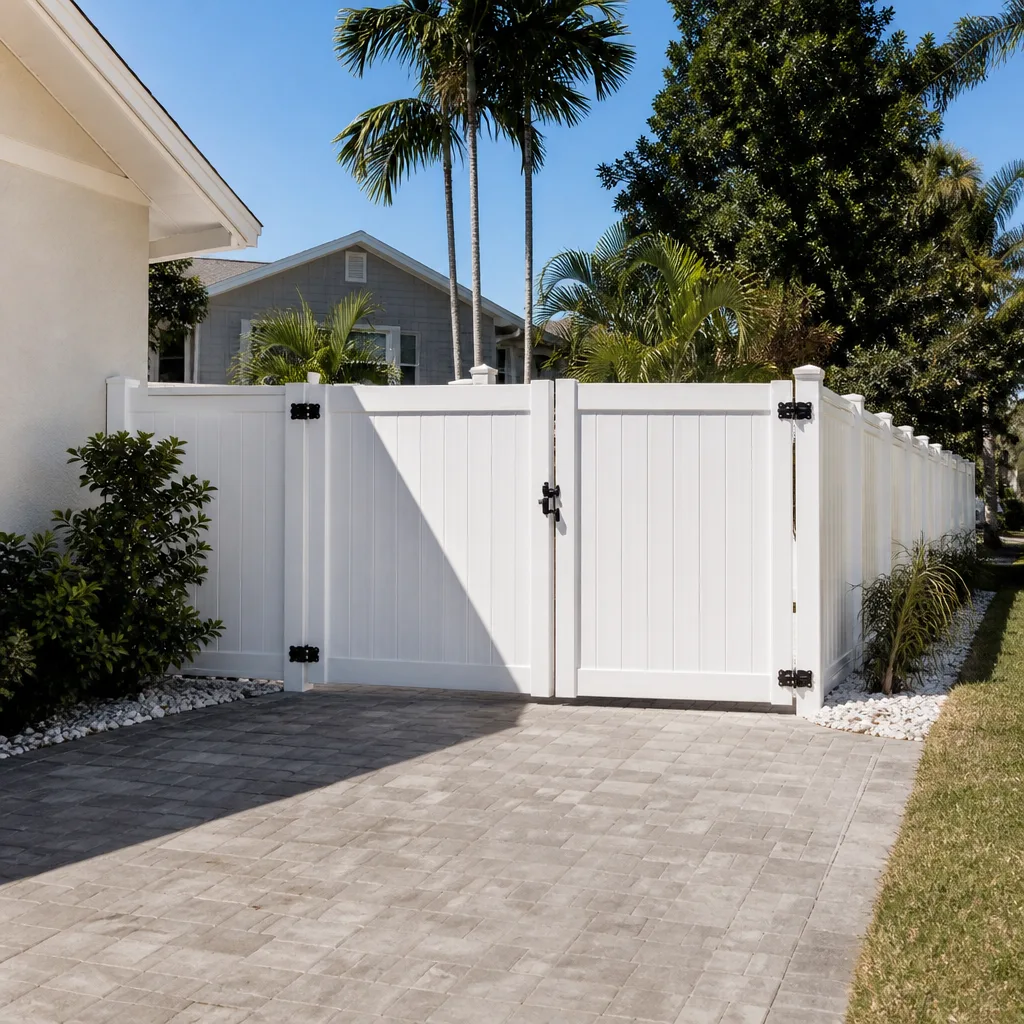
Vinyl doesn’t corrode and doesn’t need staining, which makes it genuinely attractive in coastal air. But not all vinyl is equal: specify a vinyl rated for coastal exposure with UV stabilizers, and expect to pay $28 to $45 per linear foot installed versus $22 to $35 for wood. Cheap vinyl in direct coastal sun chalks and yellows within five to seven years. Premium vinyl – the kind with a manufacturer’s warranty against yellowing – holds color for 20-plus years. The $6-per-foot difference is real money over a 150-foot run, but it buys a decade of not thinking about the fence.
Aluminum
Powder-coated aluminum is the best corrosion performer in coastal environments. Marine-grade powder coating (sometimes called a coastal or architectural-grade finish) resists chloride pitting far better than standard finishes. Expect $40 to $65 per linear foot installed. Aluminum is the correct choice for anyone building a fence within sight of the water or in the neighborhoods closest to the beach, where salt deposition is heaviest.
Steel
Steel is strong and lasts, but only with the right coating. Hot-dip galvanized steel – not electro-galvanized – is the minimum for coastal installation, and powder-coated-over-galvanized is better. Bare or painted steel in Torrance will rust from the inside of the tube outward, and by the time you see the bleed-through, the post is compromised. Expect $45 to $80 per linear foot installed.
For any material, the hardware grade matters as much as the fence body. Stainless steel fasteners, hinges, and post bases add roughly $400 to $800 to a typical project and are the single highest-return upgrade in coastal Torrance. Galvanized hardware will fail first. Stainless won’t.
Post Depth and Concrete in Torrance’s Clay Soils
The standard rule of thumb – bury one-third of the post’s above-ground height – assumes stable soil. Torrance’s expansive clay soils, particularly in the older neighborhoods and on lots that see seasonal shrink-swell, don’t behave like stable soil. The clay holds water in winter, swells, and then contracts in summer, and a post set in a hole that’s too shallow or a footing that’s too small will heave and lean within a few seasons.
Here’s what changes in Torrance’s clay:
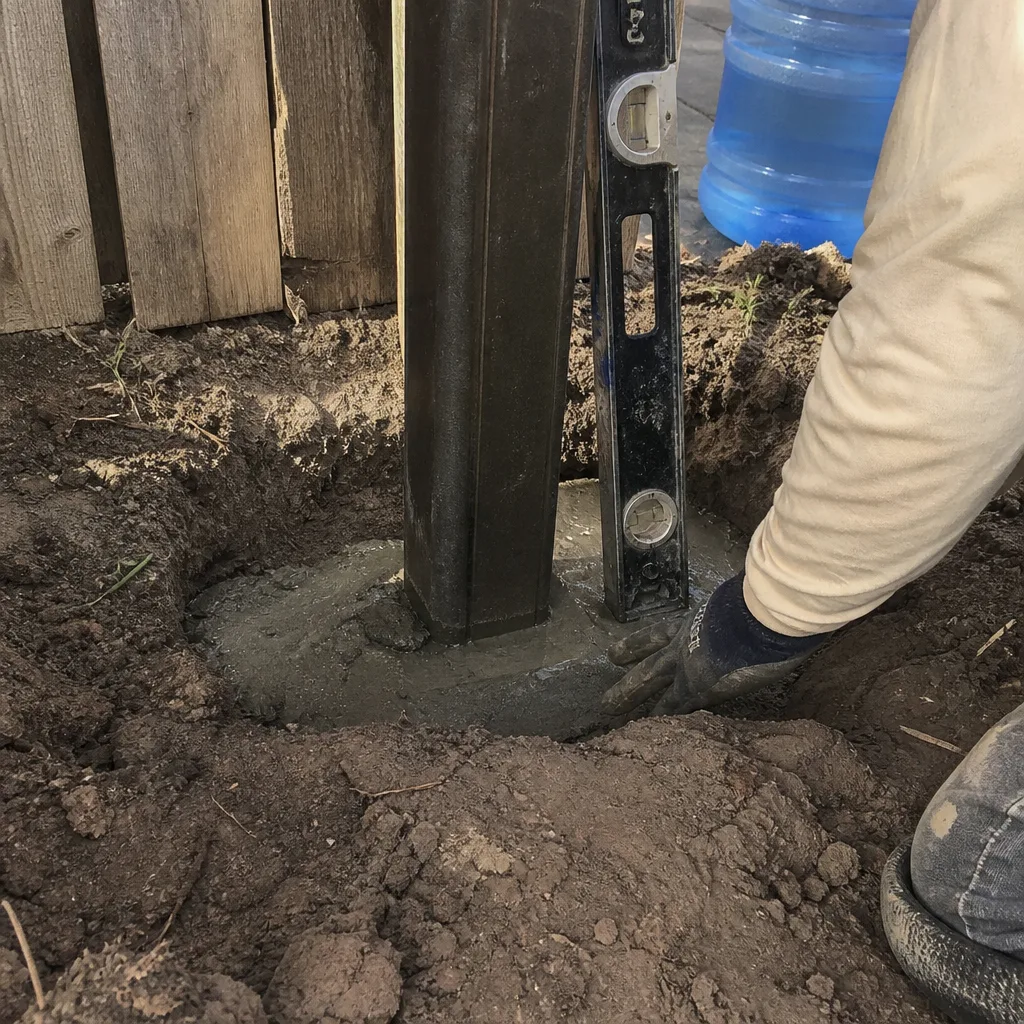
- Depth: For a 6-foot fence, 30 to 36 inches of post below grade is the working minimum, and 36 to 42 inches is safer in known expansive-clay areas. The old one-third rule gives you 24 inches on a 6-foot fence – too shallow for clay that moves.
- Footing diameter: A 10-inch diameter hole poured with 3,000 psi concrete is the standard. In expansive clay, 12 inches is the safer spec.
- Concrete mix: Specify 3,000 psi minimum, and specify it in the written scope. A crew mixing bag concrete by eye without a spec produces footings that vary from 1,500 to 4,000 psi, and the low end is where posts lean.
- Drainage: Expansive clay plus standing water equals movement. Set posts so water drains away from the footing, and don’t pour a footing into a hole that holds water.
Wind load matters too. A solid 6-foot privacy fence is a sail. Posts that are adequate for a 4-foot picket fence will flex under the Santa Ana wind events that push through the South Bay in fall. Space posts no more than 8 feet apart on center for a solid fence, and 6 feet apart where the fence is taller than 6 feet or fully solid.
This is where a contractor’s background matters. Our technicians have up to 19 years of experience setting footings in South Bay soils, and every visit includes a documented photo record – which means the depth and concrete of every post hole is photographed before the pour. If a footing is ever in question, there’s a record.
What a Written Fence Scope Must Contain
Most fence disputes we’re asked to review come down to a scope that was never written down, or was written so loosely that it described a fence without describing how it would be built. A written scope for Torrance fence work should include, at minimum:
- Post size and species – e.g. “4×4 UC4B ground-contact pressure-treated pine, 8-foot on center,” not “4×4 posts.”
- Concrete mix specification – 3,000 psi minimum, with footing diameter and depth stated per post.
- Hardware grade – stainless steel or hot-dip galvanized, explicitly. “Galvanized” alone is not a spec; electro-galvanized and hot-dip galvanized are different products with different corrosion performance.
- Attachment method to existing structures – how the fence ties into the house, a garage wall, or a neighboring fence, and whether brackets or direct fastening will be used.
- Fence height at each property line – measured from finished grade on the higher side, with the elevation noted.
- Gate specification – gate frame material, hinge type, latch type, and the swing direction. A gate specified in a single line (“one gate”) is how sagging gates happen.
- Finish and treatment – stain brand and color, or a clear “unfinished, to be stained by owner” note.
- Warranty – written, covering both materials and workmanship, with a stated term.
Rowan’s written price is a flat price with a written scope and a written warranty, and no work proceeds on a change until the change order is signed. That discipline is what keeps a fence on a 4,000-dollar budget from becoming a 6,000-dollar one when the crew hits a root or a buried utility.
If the fence is part of a larger exterior plan, it’s worth sequencing with the building envelope. Our Home Additions & ADU in Torrance page covers how fence lines, utility runs, and setback requirements interact when you’re building on the back of the lot.
Neighbor Law and Shared Fences in Torrance
California has no statute that requires a neighbor to share the cost of a boundary fence. The default rule is that each property owner pays for the fence on their own side, and a shared boundary fence is a matter of agreement between the two owners. That’s a fact worth knowing before a project becomes a dispute.
In practice, in Torrance neighborhoods where lots are tight and fences sit squarely on the line, the working arrangement is usually informal: one owner builds and maintains, the other doesn’t object. The problems start when someone wants to replace a fence that’s been there for decades and the neighbor has a strong attachment to it, or when a new fence would change the height and shade a neighbor’s yard.
Two practical moves reduce the risk:
- Get the agreement in writing, before the fence goes up – even a one-page note describing the fence height, material, and who pays for what, signed by both owners, is worth more than any conversation.
- Respect the Torrance front-yard rules – the front-yard permit requirement exists partly because front fences change the streetscape, and a neighbor who feels the fence blocks their view has a real reason to object.
When the line itself is in question, the survey comes first. A fence built on an agreed line after a survey is a fence that won’t be torn out later.
What Fence Installation Costs in Torrance
Torrance fence pricing runs higher than inland Los Angeles County for two reasons: coastal-rated materials cost more, and the clay soil in the older neighborhoods means deeper footings and more concrete per post. Here’s a working range for a typical 150-linear-foot residential fence.
- Pressure-treated pine, 6-foot privacy fence: $22 to $35 per linear foot installed; a 150-foot run runs $3,300 to $5,250.
- Cedar or redwood, same height: $30 to $48 per linear foot; $4,500 to $7,200 for 150 feet.
- Coastal-rated vinyl: $28 to $45 per linear foot; $4,200 to $6,750 for 150 feet.
- Powder-coated aluminum: $40 to $65 per linear foot; $6,000 to $9,750 for 150 feet.
- Hot-dip galvanized steel: $45 to $80 per linear foot; $6,750 to $12,000 for 150 feet.
- Stainless or hot-dip galvanized hardware upgrade: $400 to $800 added to the project.
- City of Torrance fence permit: approximately $150 to $400.
- Boundary survey (if needed): $600 to $1,500.
- Gate (single, 4-foot walk gate): $350 to $900 depending on frame and hardware.
Torrance’s clay soil can add 10 to 15 percent to a wood fence budget over the inland equivalent, because the footings are deeper and the concrete volume per post is higher. A written quote that doesn’t account for that is a quote that will grow a change order once the first hole is dug.
Common Mistakes to Avoid
- Setting posts before pulling the permit. In Torrance, a permit is required for any front-yard fence and for any rear or side fence over 6 feet, and the inspection checks post depth and footing. Posts set before the permit may have to come out.
- Treating the assessor’s plot map as a survey. It’s a tax document, not a boundary certification. Building to it is how fence projects end up in neighbor disputes.
- Using standard galvanized hardware in coastal Torrance. The hardware fails before the boards do, and the gate is usually the first casualty. Stainless steel is the correct spec near the water.
- Burying posts to the one-third rule in expansive clay. On a 6-foot fence, that gives you 24 inches – too shallow for Torrance’s shrink-swell soils. Specify 30 to 36 inches minimum.
- Specifying “galvanized” without a grade. Electro-galvanized and hot-dip galvanized are different products with different corrosion life. The spec needs the grade, not just the word.
- Leaving the gate out of the written scope. “One gate” is not a specification. Frame material, hinge type, latch type, and swing direction all need to be in writing.
- Forgetting that fence height is measured from the higher grade. On sloped lots in the Hillside and Crest neighborhoods, a 6-foot fence can read 7 feet from a neighbor’s yard below, which changes the permit threshold.
See the difference
 Before
 After
 Before
 After
 Before
 After
When to Call a Professional
A simple 4-foot picket fence on a flat, surveyed lot with easy access is a reasonable DIY project for a careful homeowner. The line moves when any of a handful of conditions apply: the property line is unconfirmed or in dispute, the fence needs a City of Torrance permit, the lot is sloped, the soil is expansive clay that needs engineered footings, the fence ties into a house wall or a garage, or the project involves a gate that has to swing true for a decade. In those scenarios, the cost of a professional installation is usually less than the cost of redoing a fence that failed an inspection or that got torn out because it sat on the wrong line.
Rowan Construction Group Torrance offers free estimates in Torrance – call (888) 349-6729. We’ll bring the written scope and the flat price to the first conversation, and a free second opinion on any written estimate if you’ve already received one. Bring a competitor’s quote and we’ll review it line by line at no charge.
Frequently Asked Questions
Yes, in two cases: any fence over 6 feet tall in a rear or side yard, and any fence of any height in a front yard adjacent to the public street. Permits in Torrance run approximately $150 to $400 depending on linear footage. Call (888) 349-6729 for a free estimate that includes permit handling – we pull the permit before work starts, every time.
A standard 150-linear-foot residential fence in Torrance runs $4,200 to $9,800 depending on material, with wood at the low end and steel or aluminum at the high end. Coastal-rated materials and stainless hardware add $600 to $1,400. Clay soils can add 10 to 15 percent over inland pricing because footings run deeper. Call (888) 349-6729 for an exact written quote – estimates are free.
For a 6-foot fence, 30 to 36 inches of post below grade is the working minimum, and 36 to 42 inches is safer in known expansive-clay areas. The old one-third rule gives you only 24 inches on a 6-foot fence, which isn’t enough for soil that shrinks and swells with the seasons. A written scope should state both the depth and the concrete mix – 3,000 psi minimum.
Yes. The marine air in Torrance carries chloride that corrodes standard galvanized hardware faster than the fence boards degrade, which means gates sag and hinges fail while the boards still look new. Stainless or hot-dip galvanized hardware adds $400 to $800 to a typical project and is the highest-return upgrade in coastal installation. Ask for the grade in writing.
A standard 150-foot residential fence usually takes two to four days once the permit is in hand, with the permit itself taking one to three weeks depending on city review. Deeper footings in clay soil add roughly a day. The permit timeline is the part that surprises people, which is why it’s the first call we make. Call (888) 349-6729 to schedule a free estimate and we’ll walk you through the timeline.
You can, but California law doesn’t require them to. There’s no statute obligating a neighbor to share boundary fence costs, so a shared-cost arrangement is a matter of agreement. Get it in writing before the fence goes up – even a one-page note describing height, material, and who pays for what is worth more than a conversation.
The Bottom Line
Fence installation in Torrance fails in predictable ways, and the failures happen before materials are chosen. Get the legal line confirmed with a surveyor, not a plot map. Confirm the permit threshold – over 6 feet in rear or side yards, any height in front yards. Then spec materials for salt air and post footings for expansive clay, and get both in writing before a post hole is dug. That sequence is the difference between a fence that outlasts its warranty and one that leans by year five. The rest is execution, and execution is where a written scope, a flat price, and a documented photo record do the work.
For a broader view of exterior projects on the same lot, start with the Rowan Construction Group Torrance home page, and see the Fence Installation in Torrance service page for scope and scheduling.
Call (888) 349-6729 to schedule your free estimate for fence installation in Torrance. We’ll bring a written, flat price and a written scope, and we’ll review any existing estimate line by line at no charge.
Written by the team at Rowan Construction Group Torrance.